
Multi-Utility Metering over a Single Communication Network
Why Utilities Need One Communication Network for Electricity, Gas and Water Metering
Utilities worldwide are expanding their smart infrastructure beyond electricity metering. In addition to smart electricity meters, utilities increasingly deploy gas meters, water meters, Customer Interface Units (CIUs), sensors and other connected devices.
A key challenge is how to integrate these devices into a single communication infrastructure while maintaining low operational costs, long battery lifetimes and multi-vendor interoperability.
The latest G3 specification and Certification Release V8 published in June 2026 address this challenge by introducing support for battery-powered RF devices that can seamlessly integrate into existing G3-Hybrid networks. Instead of deploying separate communication networks for electricity, gas and water metering, utilities can now operate a single unified communication infrastructure based on G3-Hybrid technology.
Following the publication of the updated G3 specification, the G3-Alliance certification program now includes certification of battery-powered RF devices that can seamlessly integrate into G3-Hybrid networks. The new RF-BAT certification profile extends the proven G3 certification ecosystem with dedicated conformance, interoperability and performance testing specifically designed for battery-powered devices.
This evolution enables a unified communication infrastructure for multi-utility applications.
The Challenge of Multi-Utility Deployments
Traditional multi-utility deployments often evolve into disconnected communication islands. Electricity metering, gas metering, water metering and customer interaction systems frequently operate on different technologies, different vendors and separate maintenance structures. Historically, electricity, gas and water metering systems have often evolved independently.
Utilities typically face three deployment approaches:
1) Independent Communication Networks
Each utility service operates its own communication infrastructure.
Advantages:
• Independent operation
• Technology freedom per utility domain
Challenges:
• Multiple networks to maintain
• Higher infrastructure costs
• Increased operational complexity
• Cybersecurity exposure
• Higher long-term operating costs
2) Gateway Architecture
Different technologies are interconnected through gateways.
Advantages:
• Single backend integration
Challenges:
• Additional hardware
• Complex system integration
• Gateway dependency
• Multiple communication technologies remain in operation
3) Integrated Architecture: Best Solution
A single communication network serves electricity, gas, water and other connected devices.
Advantages:
• Lower deployment complexity
• Simplified operation
• Reduced maintenance effort
• Unified cybersecurity architecture
• Lower total cost of ownership
The latest G3 specification was specifically designed to enable this third architecture.

Battery-Powered Devices Integrated into the G3 Network
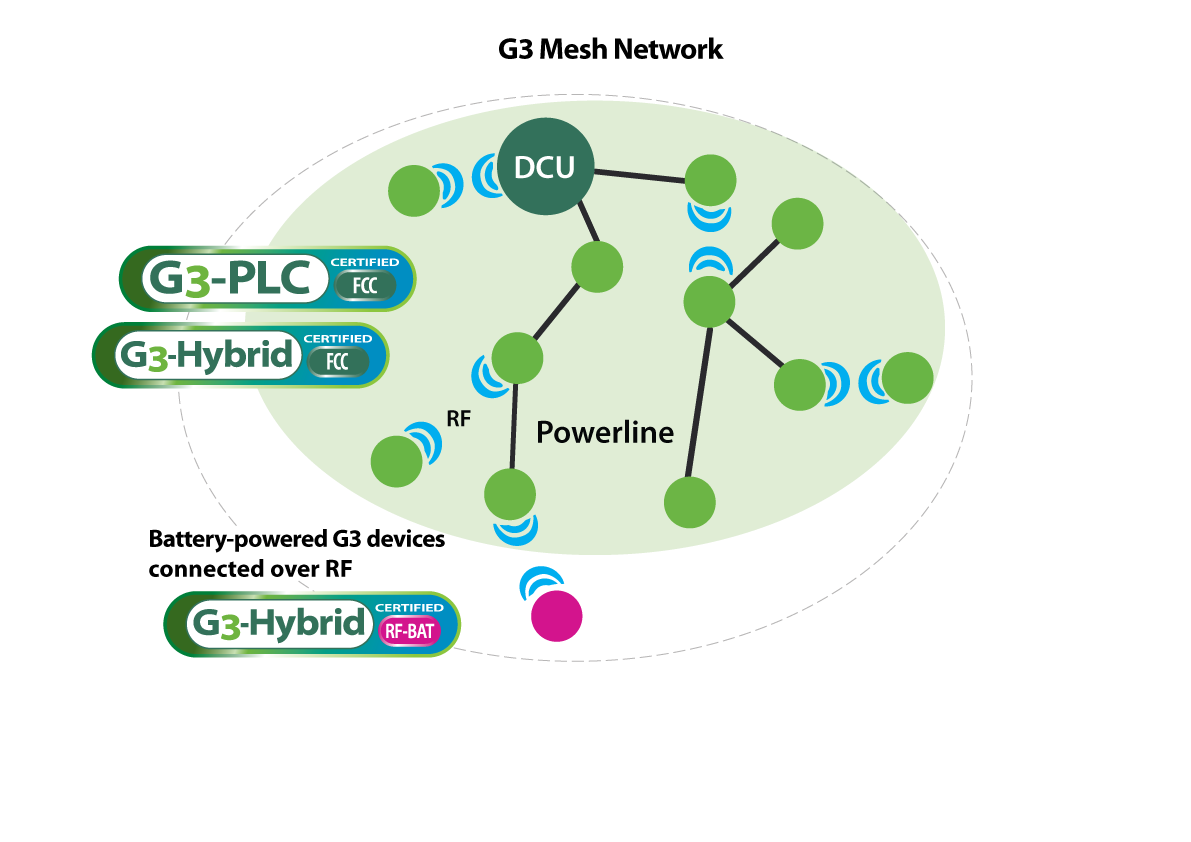
The latest G3 specification introduces battery-powered RF leaf nodes that can be integrated directly into existing G3-Hybrid infrastructures.
Battery-powered devices communicate through RF-only links using nearby G3-Hybrid devices that provide parenting functionality.
Unlike traditional mesh nodes, battery-powered leaf nodes do not participate in routing, significantly reducing energy consumption and enabling extremely long battery lifetimes.
Key technical characteristics include:
• Long deep-sleep cycles enable low-power operation
• No forwarding of messages in the mesh network
• Design target is battery lifetime of 20 years @ CR 3V/2000mAh
• Fixed channel & frequency hopping operation for global adoption
• Wake-up times and sleep cycles are configurable to support different use cases and allow battery lifetime trade-off
• Authentication and addressing are fully interoperable with G3 PLC/RF devices
• G3-Hybrid devices can parent multiple battery-powered leaf nodes
• Communication between parent and leaf node only uses RF medium
• Parent and leaf establish a unicast route (point-to-point communication) to communicate bi-directionally
• Battery-powered leaf nodes bootstrap like regular G3 devices, i.e. obtain GMKs and short addresses during the join procedure
Network discovery (for both Single Carrier and Frequency Hopping modes)
- Discovery is based on the existing beacon request/beacon exchange.
- Leaf Node (LN) sends an Enhanced Beacon Request with new “BF-IE” to enable nodes supporting LN parenting to reply positively if certain specific criteria are satisfied
Time synchronization
- Energy consumption in reception (RX) mode is much lower than in transmission (TX) mode è TX time shall be reduced as much as possible to achieve long battery lifetimes
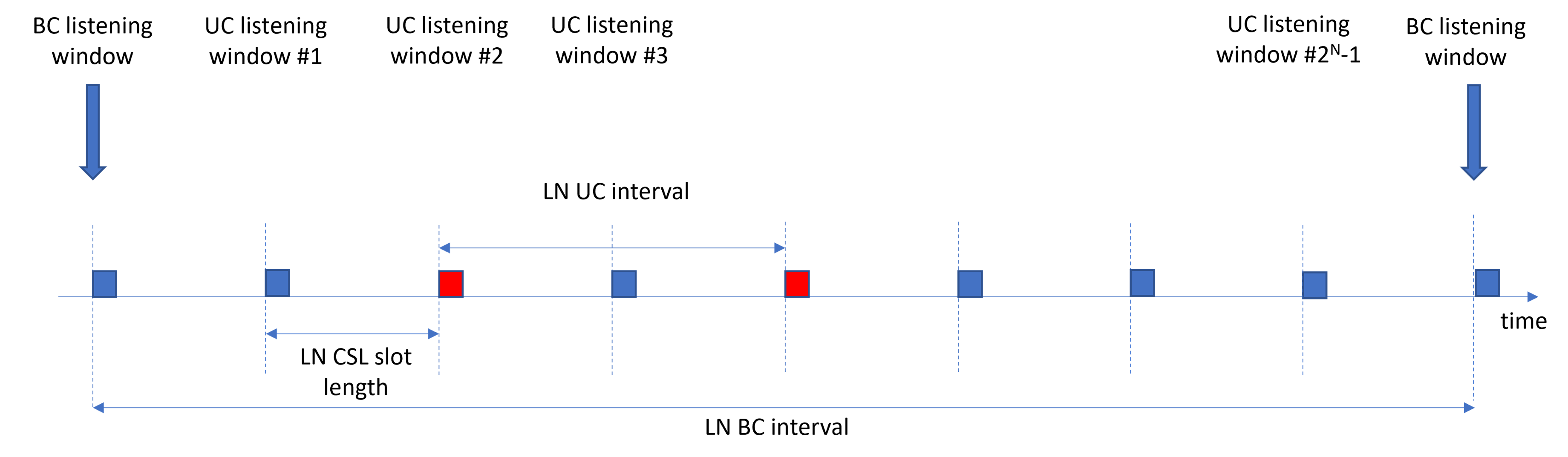
- Yet, time synchronization is crucial, especially for FH è to minimize the number of TX, a passive synchronization mechanism based on Coordinated Sampled Listening (CSL) [802.15.4 §6.12.2] is adapted for use with G3 hybrid
- To improve efficiency, an LN shall maintain two separate CSL periods:
- A broadcast period that allows reception of broadcast frames sent by a parent to all its child nodes
- A unicast period that allows reception of unicast frames sent by a parent to a dedicated leaf node
- Overview of the time synchronization schedule (comprising Unicast and Broadcast LN listening windows) determined by a parent node for all of its LNs:
Data transmission
- LN to parent communication
- Unicast: Data transmission can be initiated at any time.
- Multicast: LNs shall not initiate multicast transmissions.
- Parent to LN communication
- Unicast: Data transmission can be initiated at UC listening windows.
- Multicast: Data transmission can be initiated at BC listening windows.
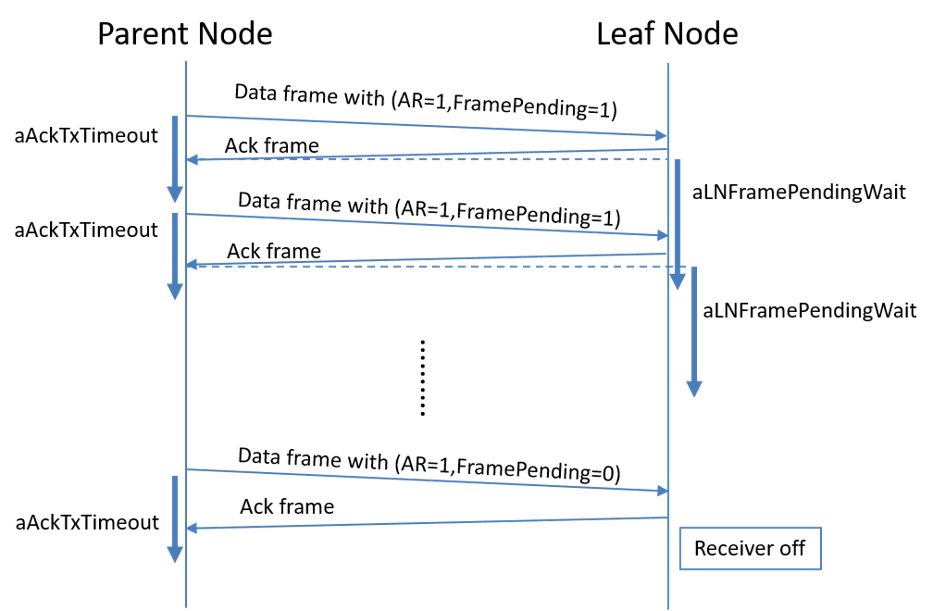
- In order to maximize the throughput, the parent node may send data continuously to its child nodes, using the Frame Pending bit set to 1.
Data transmission
- LN to parent communication
- Unicast: Data transmission can be initiated at any time.
- Multicast: LNs shall not initiate multicast transmissions.
- Parent to LN communication
- Unicast: Data transmission can be initiated at UC listening windows.
- Multicast: Data transmission can be initiated at BC listening windows.
- In order to maximize the throughput, the parent node may send data continuously to its child nodes, using the Frame Pending bit set to 1.
Information Element Definition
- Beacon Filter IE (BF-IE)
- Can be included in an Enhanced Beacon Request to control which G3-Hybrid device may reply with a Beacon frame, based on functionality support or reception quality
- Leaf Node Unicast Timing Request IE (LNUCTR-IE)
- Leaf Node Unicast Timing IE (LNUCT-IE)
- A LNUCTR-IE may be sent in a frame whenever UC time synchronization is needed (e.g. at initial join)
- A LNUCT-IE is sent in an Enh-ACK as an answer to the LNUCTR-IE received in the frame triggering Enh-ACK transmission
- Leaf Node Broadcast Timing IE (LNBCT-IE)
- A LNBCT-IE carries timing info valid for all child nodes and is present in all frames sent from the parent to its child nodes.
A Unified Architecture for Electricity, Gas and Water Metering
Using G3-Hybrid, battery-powered gas and water meters can become part of the same communication infrastructure already used for electricity metering.
Battery-powered gas and water meters benefit from:
• Existing G3-Hybrid network coverage
• Unified authentication mechanisms
• Common addressing architecture
• Shared cybersecurity framework
• End-to-end IPv6 communication
• Multi-vendor interoperability
The result is a single communication infrastructure capable of supporting multiple utility services simultaneously. This architecture reduces deployment complexity while preserving the flexibility utilities require for future expansion.
Beyond Multi-Utility Metering: Customer Interface Units, Sensors and IoT Devices
The introduction of battery-powered devices enables far more than gas and water metering.
Customer Interface Units (CIUs) represent an important example. Many utilities deploy CIUs for:
• Prepayment systems
• Consumption displays
• Customer notifications
• Energy management applications
Traditionally these devices often required separate communication infrastructures.
With the new G3 battery-powered architecture, CIUs can reuse the RF communication capabilities already present within smart metering deployments. This reduces deployment costs, eliminates duplicate communication technologies and simplifies system integration.
The same approach can be extended to sensors and other IoT devices, allowing utilities to gradually expand their smart infrastructure while maintaining a single communication backbone. The same architecture can support:
- Environmental sensors
- Grid monitoring devices
- Smart city applications
- Industrial monitoring systems
- Building automation devices
This enables utilities to gradually expand their digital infrastructure while maintaining a single communication backbone.
Interoperability Remains Fundamental
Utility communication infrastructures are expected to operate for 15–20 years or longer.
For this reason, interoperability remains one of the most important requirements for Distribution System Operators worldwide.
The G3-Alliance certification program was specifically created to guarantee interoperability across multiple vendors and generations of products.
Certification provides:
• Multi-vendor interoperability
• Backward compatibility
• Reduced supply-chain risk
• Protection against vendor lock-in
• Long-term ecosystem continuity
• Consistent performance validation
The new RF-BAT certification profile extends these benefits to battery-powered devices.

The new RF-BAT certification profile extends these benefits to battery-powered devices.
Utilities can therefore deploy multi-utility infrastructures with confidence that future products from different suppliers will remain interoperable.
Certification Release V8 Enhancements
In addition to battery-powered device certification, Release V8 introduces several important enhancements:
• FCC Subbanding: The new FCC subbanding capability enables more efficient operation within FCC frequency bands, particularly under challenging channel conditions.
• Enhanced Security: Support for AES-256-CCM encryption increases the security margin compared to AES-128 and improves resilience against future cybersecurity threats.
• Improved RF Performance: Additional mechanisms improve RF reception verification, route selection and background noise evaluation, further increasing communication robustness.
These enhancements build upon the proven G3 technology foundation already deployed worldwide.
Proven at Global Scale
More than 100 million G3 devices have already been deployed worldwide. The introduction of battery-powered devices extends the proven G3 ecosystem to support integrated multi-utility deployments while preserving backward compatibility and interoperability.
By combining electricity, gas and water metering within a single communication infrastructure, utilities can simplify network architecture, reduce operational costs and create a scalable foundation for future smart grid and IoT applications.
G3-Hybrid enables utilities to move from multiple communication silos to a single, interoperable and future-proof communication network.
Conclusion
The future of utility communications is no longer about deploying separate networks for each application. It is about creating a unified, interoperable and maintainable communication infrastructure capable of supporting multiple services over decades.
The latest G3 Certification Release V8 enables exactly this vision.
By integrating battery-powered gas meters, water meters, CIUs and other RF devices directly into existing G3-Hybrid infrastructures, utilities can simplify network architecture, reduce operational costs, preserve interoperability and minimise deployment risk.
Rather than adding another communication network, G3 enables utilities to consolidate their infrastructure around a single, future-proof communication backbone. This creates long-term operational risks:
• Higher infrastructure costs
• More gateways and integration layers
• Increased cybersecurity exposure
• More maintenance complexity
• Long-term vendor dependency
• Higher operational expenditure over the lifetime of the deployment
The new G3 battery-powered device architecture enables a fundamentally different approach.
Battery-powered RF devices can now integrate seamlessly into existing G3-Hybrid networks using the same authentication, addressing and security mechanisms already deployed in large-scale G3 infrastructures.
Instead of creating separate RF networks for gas meters, water meters or CIUs, utilities can integrate these devices directly into the existing G3 ecosystem.
The result is a single interoperable communication infrastructure across multiple utility domains.