G3-Hybrid PLC+RF
Unified PLC and RF Communication for Maximum Coverage and Connectivity
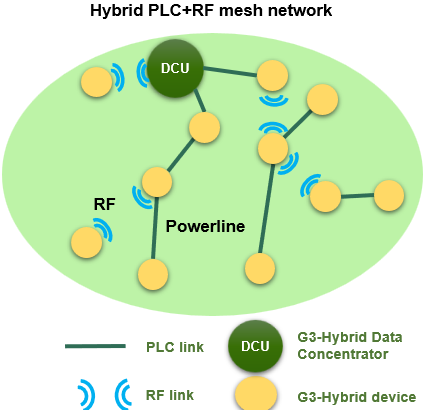
G3-Hybrid is an extension of the G3 specification that integrates wired Power Line Communication (PLC) and wireless Radio Frequency (RF) communication in a single, unified protocol stack. By combining these two media, G3-Hybrid maximizes coverage and connectivity, improves resilience, and reduces the complexity and cost of network deployment and operation.
In a G3-Hybrid network, each link can operate over either PLC or RF, with the medium selected dynamically according to actual link conditions. Medium selection is performed by the LOADng routing protocol using an extended link-cost formula that considers PLC and RF link quality, duty-cycle constraints, and noise. This ensures that every link in the network uses the most reliable and efficient medium available.
G3-Hybrid PLC+RF should not be confused with a multi-protocol router that contains separate PLC and RF chipsets carrying independent PLC and RF protocols. In G3-Hybrid, both media are part of the same protocol stack, enabling adaptive PLC or RF transmissions in a transparent way. The upper layers remain agnostic to the physical medium in use.
Introduced in 2020, G3-Hybrid is the first open standard to define interoperable, multi-vendor hybrid PLC+RF implementations. It is an optional feature of the G3 specification and is fully backward-compatible with existing G3-PLC deployments.
Key features and benefits:
-
Adaptive medium selection: Hybrid mesh networks automatically choose PLC or RF for each link based on measured performance parameters, optimizing throughput and reliability.
-
Enhanced coverage: By combining media, G3-Hybrid can achieve connectivity levels exceeding 99%, overcoming noise-related PLC limitations and RF coverage constraints such as building attenuation or interference.
-
Cost efficiency: Reduces the cost and effort of achieving complete coverage by eliminating or minimizing remediation work for hard-to-reach endpoints.
-
Compatibility and interoperability: Fully interoperable with G3-PLC devices, allowing hybrid and non-hybrid nodes to coexist within the same network.
-
Open standard compliance: Published by the International Telecommunication Union (ITU) and supported by the G3-Alliance certification program, ensuring multi-vendor interoperability.
-
Regulatory readiness: Supports multiple PLC band plans and ISM RF bands in the 860–920 MHz range, with mechanisms such as Frequency Hopping, Adaptive Power Control (APC), and duty-cycle management to meet global regulatory requirements.
-
Low-power operation: Enables integration of RF-only, low-power devices such as in-home displays, prepaid metering keypads, sensors, lighting controllers, and water or gas meters.
-
Proven industry adoption: Chipsets from six leading manufacturers are already G3-Hybrid certified, with certified platforms and devices listed on the G3-Alliance website.
G3-Hybrid extends the proven capabilities of G3-PLC into an even more versatile and resilient architecture, making it an effective solution for smart grids, smart cities, and industrial communication systems.
For further information, explore the documents provided below and discover how G3-Hybrid can transform your communication infrastructure.
Battery-Powered Devices Integrated into the G3 Network
The latest G3 specification introduces battery-powered RF leaf nodes that can be integrated directly into existing G3-Hybrid infrastructures.
Battery-powered devices communicate through RF-only links using nearby G3-Hybrid devices that provide parenting functionality.
Unlike traditional mesh nodes, battery-powered leaf nodes do not participate in routing, significantly reducing energy consumption and enabling extremely long battery lifetimes.
Key technical characteristics include:
• Long deep-sleep cycles enable low-power operation
• No forwarding of messages in the mesh network
• Design target is battery lifetime of 20 years @ CR 3V/2000mAh
• Fixed channel & frequency hopping operation for global adoption
• Wake-up times and sleep cycles are configurable to support different use cases and allow battery lifetime trade-off
• Authentication and addressing are fully interoperable with G3 PLC/RF devices
• G3-Hybrid devices can parent multiple battery-powered leaf nodes
• Communication between parent and leaf node only uses RF medium
• Parent and leaf establish a unicast route (point-to-point communication) to communicate bi-directionally
• Battery-powered leaf nodes bootstrap like regular G3 devices, i.e. obtain GMKs and short addresses during the join procedure
Multi-Utility Metering Application: A Unified Architecture for Electricity, Gas and Water Metering
Using G3-Hybrid, battery-powered gas and water meters can become part of the same communication infrastructure already used for electricity metering. The result is a single communication infrastructure capable of supporting multiple utility services simultaneously. This architecture reduces deployment complexity while preserving the flexibility utilities require for future expansion.
For more information, please visit our Multi-Utility Applications page.
Beyond Multi-Utility Metering
The introduction of battery-powered devices enables far more than gas and water metering.
Customer Interface Units (CIUs) represent an important example. Many utilities deploy CIUs for prepayment systems, consumption displays, customer notifications and energy management applications. Traditionally these devices often required separate communication infrastructures.
With the new G3 battery-powered architecture, CIUs can reuse the RF communication capabilities already present within smart metering deployments. This reduces deployment costs, eliminates duplicate communication technologies and simplifies system integration.
The same approach can be extended to sensors and other IoT devices, allowing utilities to gradually expand their smart infrastructure while maintaining a single communication backbone.
Sensors and IoT Devices
The same architecture can support environmental sensors, grid monitoring devices, smart city applications, industrial monitoring systems and building automation devices.
This enables utilities to gradually expand their digital infrastructure while maintaining a single communication backbone.
Regional regulations regarding G3-Hybrid
The whitepaper ‘Regional regulations regarding G3-Hybrid’ gathers all the studies performed by the Regional Advisory Working Group in the G3-Alliance. This document provides an overview of regional regulations globally which are relevant for the G3-Hybrid and how the different regions are supported by the hybrid specification.
The whitepaper is available for members of the G3-Alliance.
EU Regulation using Notified Body for G3-Hybrid products
In the European Union a G3-Hybrid PLC+RF product is classed as radio equipment and is controlled under the framework of the Radio Equipment Directive 2014/53/EU. Therefore, manufacturers and suppliers of these products on the EU market must prove compliance with this directive.
Compliance is commonly proven by testing against harmonized standards like EN 300 220 or EN 303 204. However, for specific use cases a harmonized standard may not exist, so compliance needs to be confirmed by a Notified Body.
To support G3-Alliance members in this process, the Regulatory Advisory Group put together a document describing the role of the Notified Body, the technical documentation to be provided as well as Procedures and Methods for assessment by the Notified Body.
The document is available for members of the G3-Alliance.
Related documents
G3-Hybrid: Two powerful communication technologies in one solution
7 Points to Understanding G3-Hybrid Mesh Networks
Multi-utility metering with G3-Hybrid
G3-Hybrid RF+PLC Communication in a single solution (Brochure)
ISPLC 2020_G3-Alliance Keynote_Hybrid communication April 2020
ADDGrup field experience with G3-ALLIANCE Hybrid in toughest conditions